


Reverse Kursk: Russian lines cracking; Ukraine on the move; more on past predictions and what we can believe...
The world is changing.
Ukrainian forces are on the attack in Zaporizhzhia, the US and Israel have attacked Iran (and Iran has since fired off missiles and drones in all directions), the Strait of Hormuz is essentially closed, oil prices are on the rise...
And nobody knows what is going to happen next.
Which means it's about time for a "War in Ukraine Update."
Yes, there has again been a gap. A risk-intel professional has to make a living, and over the past six weeks both I and my team have been submerged in quite labor-intensive work. But since this is the first blog back, let's delve into Ukraine. Is Russia cracking? Losing? Winning? And why the increased talk of the threat to the Baltics (not to mention, once again, the use of nuclear weapons) when Russian progress in faraway Eastern Ukraine is slow, bloody and casualty heavy (almost) beyond belief.
Which means the collective we will attempt to smash through the current reality in the form of a series of answers to those and other questions that hit me weekly through mail and private messages. These include questions about shotguns, trenches and long-distance drones.. and more
So let's have a quick look the fronts first, and again at least some of the answers we collectively seek can be found in current maps. However, this time around I will run through these very quickly, as a front line analysis/update is the goal of today's post.
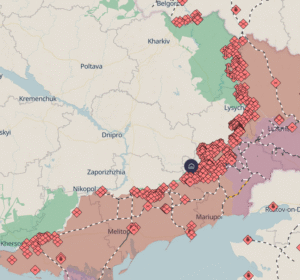
First, the traditional glance at the whole front. From a distance, it does not appear to have changed greatly over the past two months or six months or even year. That is not exactly true, as the Russians have made gains over this time, but for posterity's sake, here you go:
The front as of April 2025...
The front as of Feb. 28, 2026...
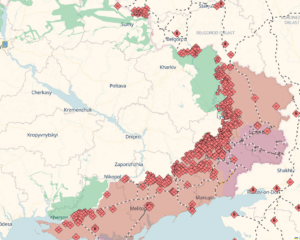
Now while the truth of the matter is that the Russian gains over the past year do seem from a miles-high view to be negligible, the pressure remains--and not only in the form of atrocities committed on civilian targets throughout the rest of Ukraine. Russia has pushed hard from North to South, with much of the momentum having begun in the spring of last year during the "shut out the lights moment" in Kursk that I've harped upon to no end. As I mentioned in my last post, that decision by the US Donald Trump administration to cut satellite access to Ukraine cost Ukraine the Kursk salient and triggered Russian successes that I noted would put into danger and eventually cost Ukraine not only Pokrovsk, but also the territory east of the "fortress/logistics" line from Pokrovsk to Kupiansk. That territory is highlighted by the blue-dotted area below with Pokrovsk next to the big blue "P," as when this map was made it was already in a struggle for life and death.
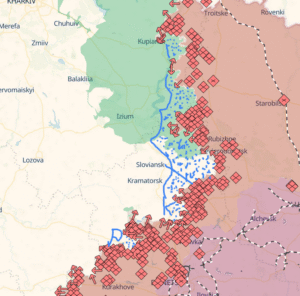
Now for the quick run through with regard to the current reality. In the map below in the far north is Vovchansk. Russia has continued to press there, but the most significant news at that front perhaps lies in reports noted by the Ukrainian SBU and also reported by the generally highly conservative Institute for the Study of War (ISW) that Russian units there in 2024 and 2025 fired "K-51 and RG-Vo aerosol grenades containing CS gas (chlorobenzalmalononitrile) and CN gas (Chloroacetophenone) on Ukrainian positions."
This is yet another war crime, but considering the plight of Russian forces on all fronts, this kind of thing will likely become more and more the norm.
Next (flowing south) is Kupiansk (seen on the same map and the following map). Kupiansk only a few months ago was all but overrun by Russian forces. As previously reported, however, the Russians got greedy and drove south on the eastern bank of the Oskil and basically created a flanking attack with nowhere to run against themselves. This degenerated into a collapse that saw Ukraine take pack the whole of Kupiansk itself (which was bolstered, by the way, by the remarkable resistance at Synkivka, which has been fought over for two years now. That said, Ukraine is under serious pressure at both Petropavlika and Pischane, and the Kupiansk pocket will not be easy to hold into the spring.
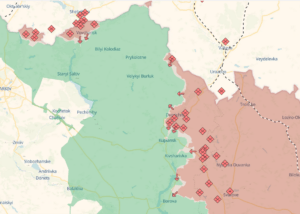
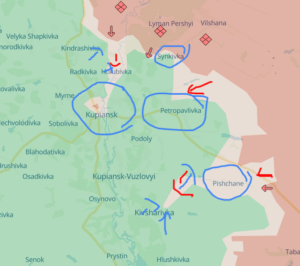
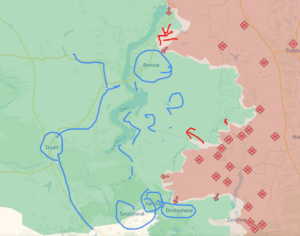
Likewise, further south of the pocket, Russia continues to press toward Borova (which did appear on the radar of Yours Truly as a goal for Russia some two years ago). Progress has remained slow, but further south Russian forces have also driven west just north of Yarova. The Borova-to-Yarova pocket is an obviously a very large area, and Russia will have a hard task taking this over, but it poses a looming danger for Ukraine in that lines of retreat are blocked by the Oskil itself, and if Russia takes the Yarova and nearby towns, it will be set to create a pocket that will be important for Ukraine to defend, but increasingly difficult to supply or escape.
Now let's turn to the key cities still remaining in the fortress line, these being Sloviansk, Kramatorsk and Kostiantynivka. The last has long been turned to complete ruin, but still Russian forces are stuck on its outskirts. That said, the Russians are all in here, with the Russian 242nd and drone teams also driving for Pryvillya, and pressing near Pleshchiivka, Ivanopillvya and Berestok.
The obvious, but also desperate play for Ukraine is to hold the line here for as long as possible and then fall back to fortified positions beyond (more on that later). Noteworthy is that Lyman is also still holding out (and this should be included in the Yarova cities/towns that are key to stopping not only the creating of a true Borova-Yarova pocket, but also to preventing or slowing the Russian targeting of Sloviansk). Russia may have at least for now bitten off more than it can chew, however, as this is not easy terrain, and they will be plagued with wetter and wetter ground, lakes, creeks, rivers, bogs (basically east of Lyman is a flood plain), dense forests and the like.
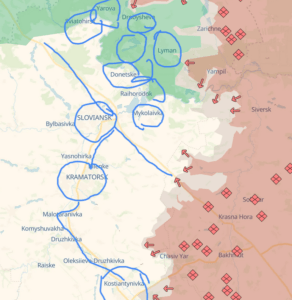
The desperate defense noted above does not mean that Russia has not had success--albeit recently at more than 30,000 casualties a month. The map below illustrates this all too clearly. Pokrovsk, which has now been lost (but from which Russia appears limited in further attacks) seemingly held forever and at great cost. But note the blue line that cuts across Russian-held territory to Kostiantynivka. This was once part of the Ukrainian supply line that was targeted more than two years ago. And the pink to the west of that line can be attributed in part to the Kursk blackout that blinded Ukrainian units there, allowed Russia to retake that territory and then diver resources to the Pokrovsk front.
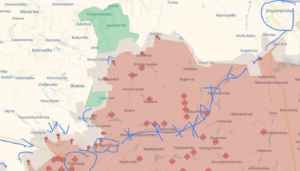
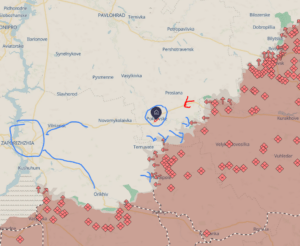
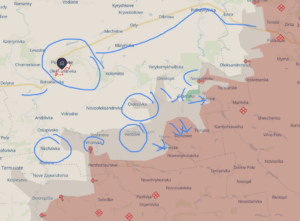
But this begs the question: just why have Russian forces moved so slowly--and why have Ukrainian forces managed to take back well more than 100 square kilometers of land East of Pokrovskie (near Ternove, more specifically) on the Zaporizhzhia front. The simple answer is that Ukraine had to do something, as indeed the road to not only Pokrovskie but all the way to Zaporizhzhia was dangerously vulnerable. But the more complicated answer appears to lie in the decision of world oligarch Elon Musk to cut off Starlink access to Russia, which blinded Russian forces much as what happened a little more than a year ago to Ukrainian troops in Kursk.
The first confirmed reports of the cutoff surfaces on the BBC in mid-February. And at least on this section of the front (seen in the maps below) it did help Ukraine.
Just why Musk decided to aid Ukraine is unclear. But, according to a recent article in the Atlantic, "The SpaceX team behind [Starlink] received clear instructions from its bosses: “'No limits. Take off the gloves; use Starlink for anything to help Ukraine.'
In fact, that article is well-worth reading--check it out here: https://www.theatlantic.com/national-security/2026/02/elon-musk-ukraine-russia-starlink/686155/
Now back to the battlefield: Those who seriously follow the war will by now have been bombarded by vlogs, articles and videos not only noting Ukraine's success, but claiming the Russian Army is disintegrating. Make no mistake, this is progress--Ukraine has achieved nothing like this since Kursk, and if vloggers are correct (which would put retaken territory in the 300-400 square kilometer range), then this is the biggest achievement since the Kherson offensive that now seems as if it took place a century ago. And there is still potential for what could become a true local route.
On the other hand, as seen relative to the entire front line, this is a very local success. It is no doubt damaging to Russia on both a personnel level and a PR level (and the latter should not be ignored), but these areas will be difficult to hold despite current Russian woes. [Ed. note--the towns circled in blue are newly freed, and it is true that this map is likely at this moment conservative, with Ukrainian forces having possible taken part of Berezove at press time].
That said, the Ukrainian counteroffensive is at least in part treated as unconfirmed by more conservative sources, and the number of towns liberated (possibly 10 or more) is actually unknown.
Now for a few often-asked questions.
Will the strikes on Iran stop the Shahed drone attacks?
No. While the Ukrainian population has obviously gotten some satisfaction out of watching the regime in Iran for once experience the reality of missiles from above, unfortunately, Iran has long since transferred Shahed technology, and current production is in Russia. Russia was already producing some 5,000 drones a month by the end of 2025, with these including the Geran-2 (Shahed-136), upgraded versions with 90-kilogram warheads. There are also more and more cheap Gerbera decoys than in the past.
Is Russia starting to break?
Perhaps my prediction (which compared present day Russia to that of the Russia that collapsed during the First World War, which I made at the end of 2025) was a bit optimistic. Russian weapons production is still staggeringly effective, although boasts by Russian President Vladimir Putin that it has increased more than 200 percent across the board since 2022 may be a bit more boast than truth. Why? There is an emphasis on modern tanks, for example, yet the realities of sanctions, the long-running war and even Russia's labor force mean that sustainability is now (finally) in question. United24 Media, for example, noted that the country is now lagging in the production of electronics, optics and combat vehicles. That said, Lance production is rather perfected and not slowing down--so yes, the might of Mother Russia does remain formidable.
That said, Ukraine's long distance strikes have hindered Russian oil production. And the manpower issue is no joke. Although support for the war remains obscenely high, the reality that a trip to the front is a one-way ticket is finding an audience even though the effort to push victory propaganda (or actually reduce the flow of even blogger news) has reached a new peak with the restricting or "throttling down" of Telegram in February and March. The new criminal prosecution of founder Pavel Durov also sends a rather clear message that no, Telegram is not the future of free and unfettered info by any means.
But take the following statement by Polish Deputy Prime Minister Radoslaw Sikorski, seen here: https://www.facebook.com/watch/?v=2377622786008386
During the conference seen above Sikorski stated that "my bet is that this war will end not like the Second World War but like the First World War — namely when Putin runs out of resources. He’s already spent his national reserve fund. His last big pile of resources is the gold reserve. He started with 2,200 tons. I hear it’s down to 1,700. So this is the thing to watch, because this is how he’s funding his war."
It should be said that a quite well-informed source did point out to Yours Truly the following:
"Pres you will recall my past remarks about gold being his final source of fungible wealth to fund the war. He has 1700 tons, but gold production number for 2025 was 310 tons, steady from 2024. 300 tons at $5k/oz = $54.5bn/year. He can fund the war indefinitely on $50bn/yr, and his many layers of security control in Russia, from the Interior Ministry to the FSB to Rosvgardia to the Army, which means he will not be ousted. And the people have no chance to revolt. I'm not as optimistic as Sikorski, as much as I love the guy."
Which is a great point. That said, when Russia is forced to sell gold, taking into consideration it's past ability to make billions out of oil... all is not well.
Meanwhile, there are reports that Putin is bolstering his Rosvgardia--and there are low-level whispers/resentment that money and personnel that should be used in the war are being harboured to the Rosvgardia out of Putin's personal fear of being toppled. No, that is not confirmed, but is it believable?
Well, yes it is.
Why the constant alarm over threats to the Baltics if Russia can't make progress in Ukraine?
First, let's take a look at what Ukraine has been up to over the past year. While it has remained under constant pressure--and while Russia did creep forward over the past 12 months (with staggering losses)--Ukraine has not been idle. In short, it has built trench lines and defenses in Donetsk, beyond the rubble of Pokrovsk and the now embattled Kostiantynivka, in and behind Kupiansk, in Zaporizhzhia and in other border regions. These consists of concrete dragon's teeth, anti-tank ditches, minefields, reinforced trench networks and more.
What this means is that--especially considering the non-stop buzz of drones overhead--that tanks and manoeuvre warfare by Russia is now difficult to believe. Likewise, Russian infiltration tactics, which often involved units as small as three or four men that slipped through Ukrainian gaps in order to congregate and then create unseen flanks (such as what took place north of Pokrovsk last year), will generally be doomed to fail.
In short, as cited by former Ukrainian Chief of Staff Valeriy Zaluzhnyi, quoted by Euromaiden: "The battlefield has become completely transparent. This led to a robotic kill zone no less than 25 kilometers deep."
Or more. Not only has Ukraine infamously taken the long-distance fight all the way to Moscow, and perhaps even more dramatically, to Novorossiysk, which, according to Reuters, "damaged 20 buildings and set a fuel terminal on fire," but which also caused the suspension of oil loading (and that port typically handled 700,000 barrels a day), but closer to the front lines drone strikes have severely hampered the ability of Russian troops to assemble in any shape or form prior to a strike.
Then why should the Baltics worry? Let's get back to tank warfare, Russia's continued focus on producing new tanks and the fact that Russia seems to be building up tank forces in the general vicinity of... Lithuania.
In short, if you cannot move in one direction, you move in another. And currently, the Baltics are vulnerable, Nato drone capabilities are behind the times, the US-Nato question is... in question.
In general, you see where I'm going. Ukraine is battered but not broken. Pushing forward there will be hard. Pushing into the Baltics? We'll see. Maybe Nato is ready.
Maybe Nato will simply...
Debate.
Let's not get paranoid, but the threat to the Baltics is real.
When it comes to drones, are shotguns effective?
This question comes up constantly, and shotguns are indeed in use across Ukraine. These are not just buy-online and shoot, but they are codified by the Ukrainian military and include the Safari HG-105M (and common as well are Italian Benelli M4s and Turkish Hatsan Escorts) but there are even new drones with "modular, 12-gauge" systems including Varta and double-barrel Winchester killer drones.
So yes, drones that are flying, tracking and shooting down... enemy drones.
That said, for on-the-ground troops shotguns versus drones is not so simple, as was explained to me by a Ukrainian officer early last year. At the time he said (and yes, I am paraphrasing here) that early in the war they were useful, and this even included shooting drones that were attempting to enter through the windows of destroyed buildings and homes during on-the-ground fighting. Yet drones had even by then developed, and they were already faster moving and, as he put it, "more aggressive," pointing out that the opportunities to shoot a drone moving across the sky laterally a la skeet shooting are not often and "somewhat unrealistic." Currently, drones that are effective still searching or loitering are too far away to hit with a shotgun and "if they haven't seen you, it's best not to be seen, as there may be others watching that can quickly overwhelm your unit if you are not careful."
Moreover, the officer in question noted that they are actually difficult to see or hear under battlefield conditions. They also target you often through relatively steep dives that give little time for a shot. When asked how long is a little, he stated: "Maybe a couple of seconds."
The upside is that Ukrainian drones--which are now the most deadly weapons on the battlefield--afford Russian soldiers (who are typically under worse command and are often sent on effective suicide missions) even less of an opportunity for survival. Add in the trench and defense systems mentioned, and the "special military operation" looks long-term indeed.
Which is ever more likely to lead to the demise of Putin himself.
The cracks are audible, friends. Right down to the foundation. Russian collapse may not be imminent, but at this rate--if Ukraine can hang on--it appears all but inevitable.
Preston Smith is a licensed investigator based in Gdansk, Poland. He can be reached at query@cddi.pl.
Photo of destruction in Odessa following a February missile attack courtesy of Dsns.gov.ua, CC BY 4.0 <https://creativecommons.org/licenses/by/4.0>, via Wikimedia Commons.