


War in Ukraine Update: Crimea cut off, Russians stalled but grinding...
To call coverage of the war in Ukraine flighty would be a compliment.
In truth, coverage has been all over the place from the start, but recent commentary (primarily over the past 10 days) has been near appalling. Yes, there has been good news. The month of May marked one more month (according to Ukraine) where Ukraine has reportedly liberated more land on paper than Russia has taken. Moreover, Ukrainian drone and missile strikes have meant that logistics to and from Crimea have been crippled--allegedly to the point of that portion of Russian occupied territory now being essentially cut off (or at least starved of petrol).
But now we are seeing a barrage of pundits, posters, bloggers and everything in between stating that Russia has already lost the war.
Some of these are the same former military types who for years (and yes, I mean years) have stated that Ukraine is doomed; that Russia will not only take the East, but also take Kyiv and essentially all of Ukraine... and that the war (including Ukrainian civilian deaths) is actually all the fault of Ukrainian President Volodymyr Zelenskyy.
Nope, I'm not going to name names, but the great flip flop has been something to see. Anything for clicks, I guess.
For there are real issues here, including 1) the war has not been lost or won (yet) 2) the people of Ukraine are still suffering and 3) while yes, I do believe Russia has begun to crack, this is a war that could still spin out of control fast.
So let's bring a bit of reality (if not sobriety) to the war and what likely lies in store.
Drone reach has expanded--but it does work both ways...
Much has been made of Ukraine's extended reach with regard to mid-range and long-range drones (and obviously, strikes on refineries and Russian energy infrastructure). A truth that has been hammered home this year is indeed that not only has Ukraine crippled Russian fuel production, but also delivery to the front lines--and this strategy (which impacts not only fuel, but other supplies, such as ammunition and even troops) has paid off. And while Ukraine's advances have been more striking, Russia has also made progress--even if much of this has centered on the stand-by terrorism of the Shahed drone, which is now being produced en masse not in Iran, but in Russia itself.
"[With regard to drones in Zaporizhzhia], things have gotten much worse over the last few months," Taisiia M. told The Corners this week. "First of all, FPV drones can now reach the city, making the life there more dangerous. Just last week, one drone hit a regular public bus. Second, there are Shahed drones flying over constantly."
Now before we continue, allow me to note that Taisiia M. has seen it all. I first met both Taisiia and her young child back in 2022 when she fled Ukraine along with hundreds of thousands of Ukrainians at the behest of her husband and family who stayed behind. She later returned with her child to her country, following the 2023 Ukrainian victories that liberated parts of the Zaporizhzhia region and Kherson, although she now is not in Zaporizhzhia itself--in part due to drone risks.
When asked about the June 9 drone attack on a residential neighborhood that saw two killed and up to 23 injured, she replied as follows:
"A few days ago, a Shahed was shot down in my neighborhood, where my husband is living right now," she added. "There are explosions in the city almost every day, hitting both critical infrastructure and regular residential buildings or other civilian areas. Our forces shoot most of them down, but the ones that get through cause terrible damage.
"Unfortunately, [in the last attack] people were hurt. This is entirely the fault of the terrorist country, which killed two women."
She also noted that no one now takes tomorrow for granted, no matter where you are located in Ukraine.
"As far as I know, one [of the victims] worked at a kiosk, and the other was just waiting at a bus stop," she said. "In an instant, two underage kids lost their mom.
"People say lightning doesn't strike twice, but just six months ago, two teenagers (a couple aged 17-18) were killed in that exact same spot," she added. "They had their whole lives ahead of them. It’s hard to believe, but people have learned to live with this. Life goes on, and everyone tries to enjoy it and even make plans. But you always know that everything can end in a split second."
Here it should be said that this nightmare has obviously continued across the country, with Russia often attempting to up the ante with even larger drone and ballistic missile strikes on large and small cities in every region.
[Ed. note--just after publication Russia launched another massive strike on Kyiv--a strike that included 50 missiles with one hitting the the Pechersk Lavra Monastery, the 1,000 year old seat of the Ukraianian and Russian (claimed) Orthodox Church.]
Crimea isolated, Russia trying to find a way...
While Ukrainians are continually bombarded, Ukraine has worked what appears to be a clear strategy to isolate Crimea--and the strategy is indeed bearing fruit. [Ed. note--the Ukrainian strategy in general seems wider-ranging and better thought out than even the most optimistic analysts believed (for example, Flamingo strikes on refineries), but for the moment let's just speak about Crimea.]. But news that bridges were being targeted, in fact, appeared to have many assuming that the Kerch bridge linking Russia proper to Crimea was the target.
This has not been (not exactly anyway) the case.
Kerch indeed is still a target, but although the bridge has been damaged in the past (most seriously in 2025), a combination of layered Russian defenses and the fact that the bridge is simply massive and incredibly sturdy appears to have caused Ukraine to shift gears. While Russia still apparently fears to send fuel transports over the bridge (in part because a strike on such a transport might cause so much damage to the already weakened bridge that it could theoretically collapse), Ukraine has actually shifted to targets on the northern side of Crimea.
These are far smaller bridges, which are also far more vulnerable to attack. And they are simply closer and easier to target with medium-range weapons.
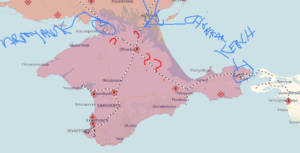
Which is to say Ukraine has made the most of it. On June 9, Ukraine hit the Chongar bridge with multiple attacks, which included FP-2 and Behemoth drones--the latter which, ironically, resembles a Shahed. On June 10-11, multiple sources cited Volodymyr Saldo, the Russian-puppet head of occupied Kherson, who stated that bridges over the North Crimean Canal near Preobrazhenka and Myrne, as well as a bridge on the Perekop-Armiansk route, and yet another at Stavky had been hit.
For a clearer idea of what his happening check out the map below where I have highlighted the areas that Ukraine has targeted in blue.
As can be seen, the Crimea supply routes being cut off do hamper Russia.
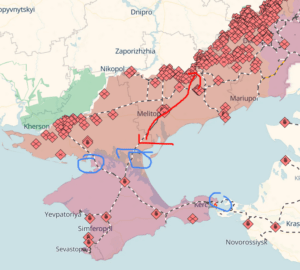
And by the reactions of Russian military bloggers, the results have been multi-fold. First, Russians in Crimea are supposedly in a state of near panic in that petrol is hard to find. Vouchers for petrol have been reportedly recalled or are simply not valid, and getting out of Dodge is not exactly simple, as even trains for civilians have been restricted. (Previously, there were night trains, but now it seems these have been canceled and only buses are allowed).
If you, Dear Reader, have little to no sympathy for Russian tourists in Crimea, you are not alone. But there are other, more serious consequences. First, bridge targeting appears to have seriously jammed Russian logistics. Replacement bridges (think pontoons) that can bear the weight of tanker trucks are not realistic, and considering the range and accuracy of Ukrainian long-range drones, such truck may get picked off even if they do get across. Second, Crimea was a key troop and supply route to Zaporizhzhia, and there should be no doubt that the strikes will benefit current Ukrainian counter-strikes in Zaporizhzhia and southern Donetsk (especially, at/near Hulyaipole).
Collapse imminent? Or not? And the south to the north...
The strikes noted above (and the supply and fuel shortages) are exactly what has prompted a slew of headlines stating that Ukraine may actually be set to win the war.
Well, I hope so, but maybe (just yet) let's not get carried away.
Yet.
The truth of the matter is that, yes, the bridge strikes (but arguably more importantly, the long-range energy infrastructure strikes) have hurt Russia badly. As has a constant drain on Russian manpower that likely surpasses 35,000 casualties per month. Starting in the south Ukraine has been making Russia pay. That said, a key Ukrainian goal is to prevent Russia from coming within "tube artillery" range of Zaporizhzhia--and it is not a given that this will be successful.
That said, Ukrainian has managed counters north of Hulyaipole, and here it does appear that Ukraine has slowed down Russian advances beyond that city. Likewise, Russia has again run into the limits of its current strategy--i.e. using glide bombs to decimates larger towns/small cities in order to then push into those cities and occupy them with ground troops. Russian troops then do have the benefit of cover, which enables them to "hide and occupy"--i.e. they can hold such cities while hiding from Ukrainian drone teams, which are pushed back into the countryside. But what then? Glide bombs are less effective in the wide open spaces, and, as the endless videos attest, Russian infiltration teams, which were last year successful, for example, north of Pokrovsk, as now routinely picked off.
Northern realities...
But moving further north and the situation is less optimal. First, while Crimea has limited routes in and out, Russia has better supply options further north in Donetsk, Luhansk (Lyman) and Kupiansk section of the various fronts. These are not ideal, as Ukraine's Magyar teams has been increasingly effective with the targeting of supply convoys behind Russian lines, but this does not mean nothing is getting through.
Which leads to the bad news.
Now almost two years ago Yours Truly highlighted the northern axis running from Pokrovsk to Kostiantynivka to Kramatorsk to Sloviansk up to Borova to Kupiansk.
In short, Russia is not a dynamic nation. It sets goals and it grinds away...
And since that time nothing about this goal has changed.
So first, the obligatory maps. First a snapshot of East Ukraine and the fronts.
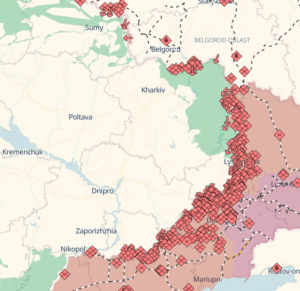
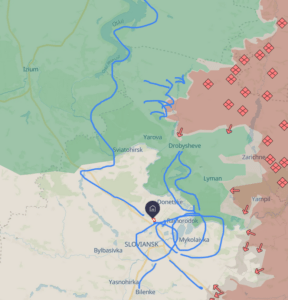
Now a map from December 25, with the territory east of the blue fortress line seen at risk.
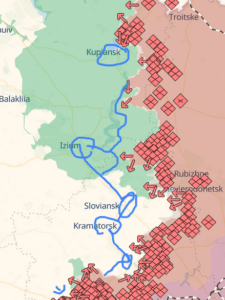
Below is the same line as of June 12, 2026, according to DeepstateUA mapping [I have shown only from Kostiantynivka north, as Pokrovsk has fallen long ago.]:
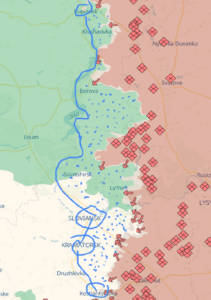
On the surface--and from a distance--there may not appear to be much of a difference. Yes, again Pokrovsk is now, obviously, long gone (although Ukraine made Russia pay dearly for that city and is still hitting back in the northwest), but the gap between the fortress line and Russian lines, as shown by DeepStateUA do not seem that different.
Unfortunately, this is not exactly the case. And moving from south to north, below is the why.
Pokrovsk and Kostiantynivka...
Northwest of Pokrovsk, Russia does not appear to mind paying twice for the same ground. Many will remember the flash Russian infiltration drive into Dobropilia back when Ukraine still held what was considered the first link the fortress city-logistics chain going north. Eventually, Russian forces did take Pokrovsk, but not before Ukraine carved up and absolutely eliminated the “fork strike” north. Yet Russia is back driving there, albeit in conservative fashion—and while it is gaining rather meters than kilometers, the goal remains the same.
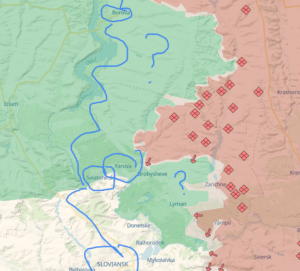
More concerning is the situation at Kostiantynivka, which, to be honest, will could fall as early as in the next week to 10 days. Or, more likely, the Ukrainians will turn it into another boiling Pokrovsk trap and drag out Russian casualties for a month to six weeks. Either way, it's fate appears to have already been decided. Here Russia used the glide-bomb/infiltration method to maximum effect, with the ISW stating noting the presence of the Russian 54th Motorized Rifle Regiment (6th Motorized Rifle Division and the 3rd Army Corps.
That said, here the ISW is a bit capricious, stating: that the "3rd Combined Arms Army (CAA, Southern Military District [SMD]), 8th CAA (SMD), and 3rd Army Corps (AC, under operational control of the Southern Grouping of Forces) are advancing in eastern and western Kostyantynivka and have seized 172 buildings in the city between June 12 and 13.
"The Russian MoD does not usually post this level of detail about alleged Russian successes in the Kostyantynivka direction, and the June 13 claims are likely part of an ongoing information effort to aggrandize tactical progress."
True, a glance at the standard Deepstate map may lead to a shrug that the situation is not good, but not yet out of hand.
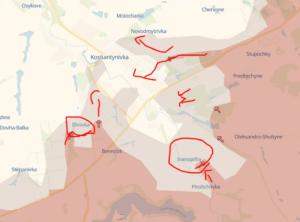
A closer look reveals provokes true anxiety, however. And as much as I'd like to agree with the ISW here, this time around I'm quite worried that the analysts there are quite off base. That city teetering toward calamity. It's not over until it's over, but it does not look good.
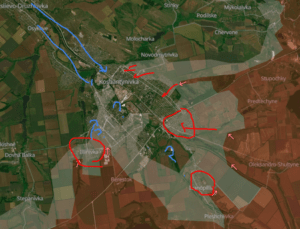
Note Ukrainian resistance at Ivanopillia and Illinivka. Ukrainian defenders have put up a remarkable defense at the former, but due to swarms of drones and open territory between the former and cover in the form of the wreckage of Kostiantynivka, retreat (highlighted by the blue "question mark") is... a real question. Will defenders at Ivanopillia fight to the last man? As so often seen during the past year of this war, they may well have no choice. At Illinivka, which has been attacked by Russian troops scores of times just over the past weekend, the situation is only slightly better in that the distance to cover and Ukrainian positions is somewhat closer, and here Ukrainian counters have teeth.
That said, even troops hunkered down in the center of Kostiantynivka are enduring hell on earth. Russian infiltration is constant, and when it stalls... glide bombs are often incoming. And there is the risk of becoming completely cut off. The silver lining here are supply routes that still exist into the city, but overall, the situation is grim.
Further north, the silver lining remains Kramatorsk and Sloviansk, which--although constantly hit from the air--are still relatively distant from the lines... on paper. That said, Sloviansk appears to be the next priority for Russia, and as noted by the red highlights, the enemy is pressing hard in that direction from the southeast, although it has been met with fierce Ukrainian resistance. Likewise, distance or no distance on paper, Russian infiltration operations are already constant. Sloviansk does benefit from lakes and wet terrain to the northeast, but it's worth keeping watch there, as well as on the Russian offensive and Ukrainian counters in Lyman, where Ukraine has at least recently more often than not caught Russia off-guard.
In fact, watch this space. Over the past 48 hours Ukrainian advances north of Lyman have appeared to be... dramatic. This could take the steam off of Russian aspirations further south. Chiefly, I'm thinking about Sloviansk here, but maybe the fate of Kostiantynivka is not yet decided after all.
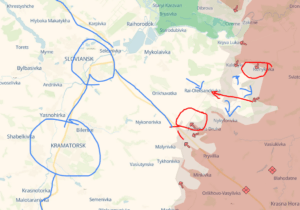
Borova... and Kupiansk
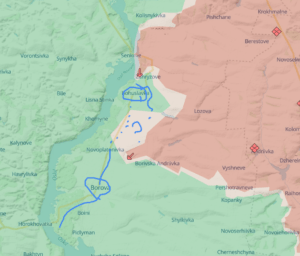
More concerning is the Borova to Kupiansk section of the line. Russia is pressing toward Borova, as seen in the map below, although Ukrainian defenses have proven stiff near Zelena Dolyna and Zahryzove.
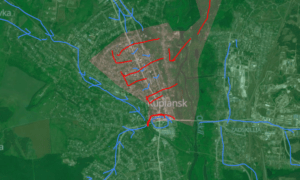
Far more concerning at this moment is the plight of Kupiansk. Sources for The Corners, as well as various bloggers and open-source tippers indicate that Russia has broken back into Kupiansk over the past days. Readers who have followed the war may remember there was a time when Ukraine essentially lost Kupiansk, and the plight of Ukrainians trapped in the pocket east of Kupiansk (and those apparently bottled up against the Oskil spelled disaster. It was at this moment, however, that Russian generals moved down the west side of the Oskil in a suicide move that set them up to be hit across a long flank with no hope of reinforcements or supplies. Ukraine did just this and then drove right back into the heart of Kupiansk, cleaning it up and out through the winter and early spring.
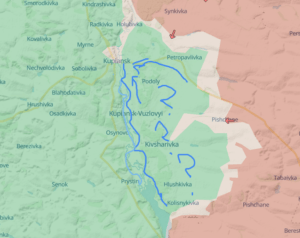
Now, however, the tide at Kupiansk may have changed again, and once again, the question of the state (and potential avenues of retreat) for Ukrainians in the pocket to the east are as relevant as ever.
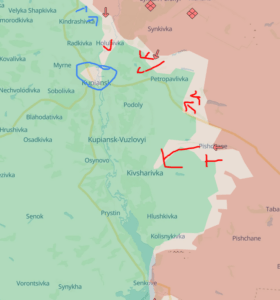
A primary question here is again the intersection of Ukrainian supply lines in Kupiansk itself. These are key to supplying Ukrainians in the Kupiansk pocket. And once again there is the plight of said defenders, who will find evacuation difficult, as there is 1) much open ground 2) the Oskil barrier (if they can get that far) and similarly deadly Russian drone coverage to that faced by Russians who have been infamously decimated by Ukrainian drone teams.
A closer look at Kupiansk itself (and note that it is almost all disputed now, according to Deepstate maps, which is unnerving, considering even more pessimistic reports communicated to Yours Truly. The key crossroads is at the southern tip of the grey area. This is followed by a map noting that retreat for Ukrainians in the pocket does (generally speaking) lead back to that same choke point.
It should also be noted that in Kupiansk Russia appears to be all in. Infiltration attempts are not only ongoing within the city, but also Russian forces have attempted to cross the Oskil repeatedly north of the city (although, again at a very high price, as Ukrainian drone operators have had a field day here).
Which is a silver lining of sorts.
Still... Russia is cracking. Russian President Vladimir Putin will now be forced to mobilize on a broad scale in the face of not only discontent within a subdued public, but also discontent that is rising to the surface among officials and politicians. Further nationalization of Russia's private companies (with oligarchs seemingly targeted on a daily basis) is only a band-aid solution liable to become unstuck... and risk infection.
And surprisingly, the overall futility of this war may finally be slowly seeping upward [emphasis on the word "slowly"]--and since we are quoting the ISW today, note that here, according to the ISW, "Putin also acknowledged that Russian forces are not advancing 'as quickly as we [Russia] would like; but hedged that Russian forces are still advancing 'every day gradually.'
Which is still not quite calling it as it is, but when it comes to Putin and the truth...
It's something anyway.
Preston Smith is a licensed investigator based in Gdansk, Poland. He can be reached at query@cddi.pl.
Maps courtesy of Wikimedia Commons.
Photo credit: Bombing damage in Selydove following a June 2 attack. Dsns.gov.ua, CC BY 4.0 <https://creativecommons.org/licenses/by/4.0>, via Wikimedia Commons.