

War in Ukraine Update: Situation Critical as Russia presses forward at Kupiansk and Pokrovsk
This week we are going to keep coverage relatively simple and blunt--in part due to the fog of war and in part due to the need to wait for answers to questions that are growing more critical by the moment.
Put simply, the news is grim. That said, Ukraine is still making Russia pay, as the battle of "who will break first" rages to new levels. Highlights on the Ukrainian side include yet another Ukrainian Intelligence/SBU victory in the destruction of an advanced Oreshnik missile deep inside Russia. Yet this is at most a PR victory, as this did not happen this week or last week, but back in 2023, prior to the missile's "debut," according to Security Service of Ukraine (SBU) Chief Vasyl Maliuk, as cited by international media.
Meanwhile, Ukrainian long range strikes have continued cripple Russian oil production, with Maliuk adding that close to 160 Russian oil production and refining facilities have been successfully targeted, including 20 such sites in September and October," according to both Ukinform.net and Euromaiden Press.
Just what this means when it comes to the big picture is difficult to state, with analysts stating that anywhere from a 20-40 percent reduction in production capacity. That said, The Corners was supplied with a thought provoking summary by former Moscow investment banker, Scott Licamele, that noted that in late September production capacity had already been crippled by 39.2 percent, with the "critically compromised" mark predicted to take place at the magic percentage of 40 percent.
As more than 80 percent of refineries are already in "Flamingo-missile" range (with technically only six out of reach), Licamele-- whose data collection methods are convincingly through and range from geo-spatial location to refinery thermal signatures to access to top petroleum industry analysts and refined product shipment tracking--predicted the likely 60-70 percent destruction of Russian fuel production over the next six months.
And the Ukrainians may push this higher.
This is thought provoking to say the least--and it is a game changer when it comes to the history of war, as the Allies during World War II were noted to have severely compromised German fuel access by 1944, with this coming after years of night and day heavy bombing runs that cost the Allies dearly.
Yet Ukraine is approaching this, following an extremely short campaign with drones and home-made missiles.
Again, Russia may be winning local battles at this time, but it will take much to turn around what so far appears to be a strategic defeat that risks imploding that nation in the medium term.
But now to the reality on the ground. And again... it is grim.
The short and simple summary is as follows: Ukraine and Russia are slugging it out for Pokrovsk, both on the outskirts and from within. Kupiansk is much the same, although there questions of trapped Ukrainians are... unfortunately real.
This is not to say that Ukraine is "only" under pressure along the fortress-city line. Sources have also indicated difficult fighting in Zaporizhzhia (and expect both the Russian offensive toward Pokrovskie and further south in the sector north of Robotyne to gain steam. As a source put it (relaying information from a soldier at the front):
"It's loud in Zap. Very rough at the front."
But again, this week we are going to keep this update relatively succinct, not counting a high number of maps.
First, the obligatory review. As noted prior to but especially since the "turn out the lights" incident in March in Kursk (see: Pulling the Rug out from Under the Ukrainians post here: https://thecorners.pl/pulling-the-rug-out-from-under-the-ukrainians/ ) I have highlighted that Kupiansk and Pokrovsk would come under intense pressure, precisely as fallout of this incident; that Russia would then move resources to both Pokrovsk and Kupiansk, and that these two points could eventually fall, costing Ukraine the entire fortress-logistics line and the territory east of this line.
While I will also highlight here that I do not see this as costing Ukraine the war (and in fact, Russia's insane appetite for losses will likely be the key to a grand strategic defeat), this prediction still remains worryingly on track.
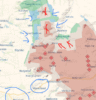
Below is a big-picture map that indicates the current situation from Pokrovsk to Kupiansk (as of Oct. 30).

In the above map, the areas marked with a blue "question mark" east of the blue line represent territory eventually risk. The small blue "x's" represent Ukrainian forces in danger of encirclement. I have repeatedly noted that the fall of Pokrovsk and Kupiansk will enable Russia to move forward and take those areas, due to resulting supply difficulties. It should be assumed that said supply difficulties have long since begun due to the fact that both Kupiansk and Pokrovsk, the latter once a key logistics hub, have long been compromised by advancing Russian forces and this year's exponential drone coverage.
Kupiansk...
In order to understand the "Kupiansk risk," below is a second map that outlines the Kupiansk to the Lyman front/Sloviansk.

In the above map, the large X is an area of de-facto encirclement in the sense that Ukrainian forces have had tactical retreat dangerously complicated. This may be debated (and generally is denied by Ukraine), but my extremely stressed explanation will follow. The "dotted areas" represent territory at risk. Key to this blue line and the (which will also, I believe, become a very difficult barrier for Russia to cross) is the Oskil waterway--and drone coverage.
That said also note that, despite mantras in standard press and blogs, the Russian offensive is not over, and it is not one dimensional. Russian forces are also pressing (albeit piecemeal) at Dvorchina (north of Kupiansk); toward Borova from the north and east; toward Sviatohirsk (and here this is a more concentrated drive) and at Lyman.
Now back to Kupiansk. In the first map below the "Kupiansk pocket" is shown. This is a DeepstateUA map, and thus it is quite a conservative take. That said, not the grey-pink areas where Russian forces are acknowledged to be pressing the matter, although not in full control.
That said, in short, the map below would not seem at first glance that much different than what I posted last week. The battle for the center of Kupiansk rages, which means a key supply crossroads is blocked, but this was already the case. Synkivka is still holding out, as is, possibly, Pischane further south. The Oskil is a barrier for retreat, but no reason for panic.
This is likely to be a very optimistic version of the story.
The Kupiansk pocket as of Oct. 30, 2025

In fact, Ukrainian troops in the above pocket are in trouble. No, this cannot (yet) be called encirclement, at least not on a military technical level. Yet the combination of drones, fighting in the center and to the west of Kupiansk and the Oskil waterway has left potentially thousands of Ukrainians cut off and in grave danger should they attempt a tactical retreat.
In the map below this is made more evident. Not the following (and this map has already changed). The grey-pink areas are conservative areas of engagement, and in fact at this time (and even when this map was made on Oct. 31 it was believed that these areas were under near Russian-control. The line north to south from Kupiansk to Senkove highlights the Oskil, and this is becoming near impossible to cross, with Russian drone operators and artillery having long targeted even the smallest of bridges, and pontoon bridges are routinely hit. The "double" blue line to Pischane represents not only a supply road, but an avenue of retreat for vehicles, only supplies are cut back in Kupiansk, and that road is under attack (and the advance, such as that shown at Pischane is depicted in highly conservative form). The "orange patchwork" area does not have cover to move under Russian drone coverage, and more and more believable reports note Ukrainian forces increasingly trapped against the east bank of the Oskil, with Russian bloggers claiming "encirclement" in the sense that the Ukrainians are backed into a corner.

A closer look at Kupiansk does not dispel such claims. In the map below (from Oct. 31, 2025), highlights the above (the orange dots are no-go areas due to drones), and the following map notes the grey areas, which represents at minimum geo-located fighting and at maximum Russian control. It should be noted that it is highly likely that by the time you read this blog that Pischane, Petropavlika and Kucherivka will already be gone--and in fact the first two are certainly under tremendous pressure by Russian forces, as noted also by the ISW, with "drone operators and other elements of the Russian 47th Tank Division (1st Guards Tank Army [GTA], Moscow Military District [MMD]), including its 272nd Motorized Rifle Regiment and 375th Separate Anti-Tank Artillery Battalion, [...] reportedly operating in the Kupyansk direction.
Chiefly, it should be understood that Ukrainian troops in the eastern areas of the pocket should likely have already begun efforts to retreat, but they may well be stuck holding on as long as possible under extreme conditions.


Following the line south of Kupiansk, Russian forces are pressing toward Borova, Sviatohirsk and Lyman, as can be seen on the two maps below. In the second map, Kostiantynivka is noted (furthest south). Only months ago this was still a rear rest area, but it is now under Pokrovsk-like pressure, and suffering under Russian drone attacks, with Russians also attempting to infiltrate small teams near constantly.


The battle for Pokrovsk...
That said, we will now focus on the Pokrovsk sector. While the media headlines have focused on Pokrovsk as a critical logistics point, here are five truths to now understand:
1) The city was compromised as a logistics/supply point long ago.
2) This appears to now be a battle to prevent a Russian PR win, although the Ukrainian brass is coming under increasingly critical response even at home (such as in this Euromaiden article titled "Ukrainian troops nearly cut off as Pokrovsk defense strategy fails" (https://euromaidanpress.com/2025/10/31/pokrovsk-surrounded/ )
3) The number of fighters within Pokrovsk may be as few as 3500, with Ukrainian forces numbering 60-70 percent of this figure, but with Russian infiltration units and suicide runs of troop transports--many of which are destroyed-- evening the odds by the hour.
4) The question for top-tier Ukrainian troops in the city is likely similar to Kupiansk--will it be possible to get out? This is especially true for those furthest east (and for those still fighting in Myrnohrad).
5) Finally, the battle for Pokrovsk is not happening in isolation. This can be seen also below, as to the south of Pokrovsk the Prosiana-Pokrovskie sector (not to be confusing) is heating up, and again, a renewed battle for Zaporizhzhia still further southwest is beginning.

But now, finally, Pokrovsk itself. In truth, the reality on the ground has been changing daily, and it is almost impossible to map with fighters on both sides battling it out among the wreckage, but also with both sides often unable to move, due to drone strikes. That said, Russian forces have made it increasingly difficult for Ukrainian drone operators to remain in operational range. On the flip-side, Ukrainian defenders do have the advantage of being able to sporadically use armor (often in the form of armored personnel carriers) within the (at best) five-minute window necessary for Russian operators to identify vehicles and armour and to get drones on target.
Indeed, the situation is dynamic, as is indicated by the map below. Noteworthy is that while on the DeepstateUA map Russian forces still see to be distant from Kostiantynivka, this is not the case, and reliable reports put them on the edge of or pushing into the edge of the city. Also noteworthy is that the Russian breakthrough northwest of Pokrovsk has been eliminated. This has garnered much press, but possibly it has also cost the Ukrainians dearly in terms of casualties and men needed further south. Within Pokrovsk I have highlighted the Russian pincer (the blue bi-direction arrow represents the corridor for Ukrainians to get supplies in, as well as wounded or retreating soldiers out). Note also the helicopter (alas, I am not an artist). This represents a daring move by Ukrainian special forces who reportedly were ferried in Vietnam-style by helicopter, drones be damned, to hit Russian forces and weaken said pincer and open he key lifeline to forces battling within the ruins of the city.

Like I said, the situation is dynamic.
Taking all of the above into consideration, below are Pokrovsk-focused maps since Oct. 30:
Oct. 30--Russian forces push from the north and the south, with pincers forming northwest of the city.

Oct. 31--a map noting the reality of Russian presence, although this is not necessarily Russian control. Additionally, there are reports of sharp Ukrainian special forces strikes, including helicopter strikes and deliveries of men on the "southern pincer). Note the pincers beginning to close, but also the vulnerability of defenders assumed to still be in Myrnohrad, not to mention those at the most southeastern points of the pocket:

Below is seen an approximation (again, likely conservative a la DeepstateUA) that reveals the pincers beginning to close. This is a narrow corridor--in the old days maybe a 10-minue car-ride wide, with the blue double-ended arrow representing a theoretical lane for Ukrainian forces able to get in and out. However, this is very theoretical--as in highly unlikely-- as will be seen on the next map. That said, the situation is fluid, and both Russian and Ukrainian forces likely dot the entire pocket at least in the wreckage of the city.

Below is a second shot (same date) with the city-scape shown. Here the reality is more troubling. The center of that supply-escape corridor is not realistic (hence the "X's") as there is no cover. These are open fields. True, I have highlighted the grey-pink disputed areas with a red line--and these should not yet be considered to be in Russian hands--but they also should not be considered to be under Ukrainian control, which means that getting supplies in and out to Myrnohrad means attempting to stick to the rubble and skirt the pressure of Russian forces either to the north or the south. Again, it should be stated that the situation in the grey-pink zones is hardly clear, as house-to-house fighting (in short-collapsed tenement to collapsed tenement) fighting is ongoing, with drones hitting both sides, but note that the center of Pokrovsk is currently disputed. Also, it is unclear as to whether Ukrainians assault teams brought in, apparently, to the western side of Pokrovsk were successful, as some war bloggers have claimed all were killed, while others have stated that the Russians took heavy losses and supplies are now moving. This is the complete fog of war, and as of 21:00 on Nov. 1, nothing is known.

To conclude, the above should indeed be considered a crisis situation, and the Ukrainian strategy here is unclear at best. Ukrainian bloggers and writers are already criticizing the defense of Pokrovsk and stating, probably accurately, that there will be troops--including elite troops--who will not be able to get out once the wreckage of the city if finally deemed lost. The most negative believe that troops should try to "exfiltrate" much as Russian teams are infiltrating, but this is clearly a dire challenge--as the pocket is likely facing a force of some 100,000. The most concentrated attacks are coming from the south, but Myrnohrad is also being hit hard.
And as for official statements, on Nov. 1, Commander in Chief of the Ukrainian Armed Forces Oleksandr Syrskii stated that Pokrovsk is not encircled, and that "We are holding Pokrovsk." And that the operation to push the Russians out is "ongoing." Concurrently, Ukrainian President Volodymyr Zelensky repeated Saturday that the defense of Pokrovsk is a "priority."
Much will be known over the next week if not the next few days.
But God help the men holding onto what is left.
Slava Ukraini. Heroyam Slava.
Perhaps this is all there is left to say.
Preston Smith is a licensed investigator based in Gdansk, Poland. He can be reached at query@cddi.pl.
All maps courtesy of Deepstate UA.